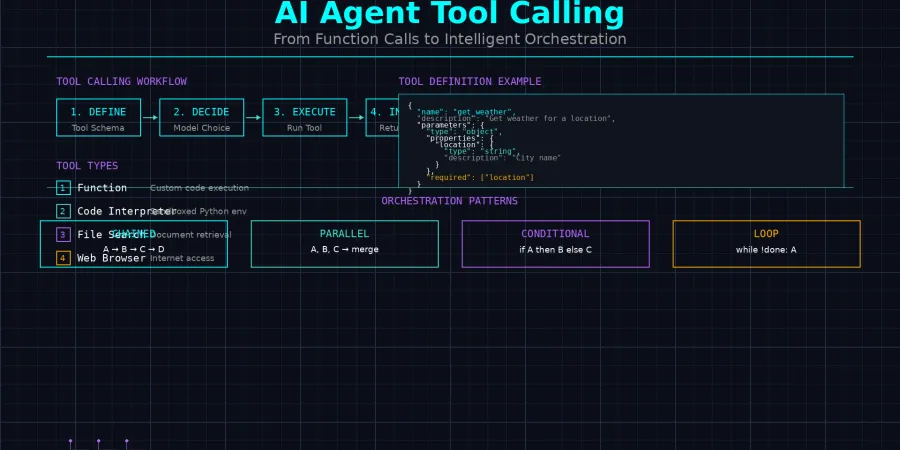
AI Agent Tool Calling:从函数调用到智能编排的深度解析
深入剖析 AI Agent 工具调用机制的设计原理、实现模式与最佳实践,探索从简单函数调用到复杂工具编排的技术演进
开篇:工具调用——Agent 的「手」
如果说大语言模型(LLM)是 AI Agent 的「大脑」,那么工具调用(Tool Calling)就是它的「手」。
没有工具调用的 LLM,只能停留在「纸上谈兵」——它可以告诉你怎么做,但无法真正执行。工具调用的出现,让 AI Agent 从「聊天机器人」进化为「行动者」。
2026 年,Tool Calling 已经成为 AI Agent 开发的核心技术栈。OpenAI、Anthropic、Google 等主流厂商都在快速迭代各自的工具调用协议。但工具调用远比「让模型调用一个函数」复杂得多。
本文将深入剖析:
- Tool Calling 的底层原理是什么?
- 主流实现方案有何差异?
- 如何设计可靠的工具调用系统?
- 工具编排(Tool Orchestration)的最佳实践?
第一层:理解 Tool Calling 的本质
从 Function Calling 到 Tool Calling
2023 年 6 月,OpenAI 首次在 GPT-4 中引入 Function Calling 功能。最初的 API 设计非常简洁:
{
  "name": "get_weather",
  "description": "Get current weather for a location",
  "parameters": {
    "type": "object",
    "properties": {
      "location": {
        "type": "string",
        "description": "City name"
      }
    },
    "required": ["location"]
  }
}
模型在需要时返回:
{
  "function_call": {
    "name": "get_weather",
    "arguments": "{\"location\": \"Tokyo\"}"
  }
}
这套机制迅速被行业采用。但很快,开发者发现:
- 单一函数粒度过粗:一个函数只能做一件事,复杂任务需要多个函数配合
- 无状态管理:函数之间无法共享上下文
- 错误处理困难:函数失败后如何恢复?
2024 年,OpenAI 将 Function Calling 升级为 Tool Calling,引入更灵活的概念:
{
  "tools": [
    {
      "type": "function",
      "function": {...}
    },
    {
      "type": "code_interpreter"  // 内置工具
    }
  ]
}核心变化:从「函数」到「工具」的概念升级。工具可以是函数,也可以是代码解释器、文件检索器、网络浏览器等更复杂的实体。
Tool Calling 的工作流程
一个完整的工具调用流程包含四个阶段:
┌─────────────────────────────────────────────────────────────┐
│                    Tool Calling Workflow                     │
├─────────────────────────────────────────────────────────────┤
│                                                             │
│  1. TOOL DEFINITION                                         │
│     ↓                                                       │
│     定义工具的名称、描述、参数schema                           │
│                                                             │
│  2. MODEL DECISION                                           │
│     ↓                                                       │
│     模型根据用户输入决定是否调用工具、调用哪个工具               │
│                                                             │
│  3. TOOL EXECUTION                                           │
│     ↓                                                       │
│     执行工具,获取结果                                        │
│                                                             │
│  4. RESULT INTEGRATION                                        │
│     ↓                                                       │
│     将结果返回模型,生成最终响应                               │
│                                                             │
└─────────────────────────────────────────────────────────────┘关键洞见:Tool Calling 的核心不是「调用」,而是「决策」。模型需要在以下选项中做出选择:
- 不调用任何工具,直接回答
- 调用单个工具
- 同时调用多个工具(并行)
- 按顺序调用多个工具(串行)
这个决策过程,是 Tool Calling 技术的核心难点。
第二层:主流实现方案对比
OpenAI Tool Calling
OpenAI 的实现特点:
并行调用:模型可以一次返回多个工具调用:
{
  "tool_calls": [
    {
      "id": "call_abc123",
      "function": {
        "name": "get_weather",
        "arguments": "{\"location\": \"Tokyo\"}"
      }
    },
    {
      "id": "call_def456",
      "function": {
        "name": "get_weather",
        "arguments": "{\"location\": \"Paris\"}"
      }
    }
  ]
}强制调用:通过 tool_choice 参数控制调用行为:
// 强制必须调用某个工具
"tool_choice": {"type": "function", "function": {"name": "get_weather"}}

// 强制必须调用任意一个工具
"tool_choice": "required"

// 模型自主决定
"tool_choice": "auto"限制:
- 最多支持 128 个工具
- 单次响应最多 32 个并行调用
- 无内置状态管理
Anthropic Tool Use
Anthropic 采用不同的设计理念:
结构化输出优先:工具调用被视为一种特殊的结构化输出:
{
  "content": [
    {
      "type": "text",
      "text": "I'll check the weather for you."
    },
    {
      "type": "tool_use",
      "id": "toolu_abc123",
      "name": "get_weather",
      "input": {"location": "Tokyo"}
    }
  ]
}思考过程显式化:支持 thinking block,让模型的推理过程可见:
{
  "content": [
    {
      "type": "thinking",
      "thinking": "User wants weather info. I should call get_weather with Tokyo as location."
    },
    {
      "type": "tool_use",
      "name": "get_weather",
      "input": {"location": "Tokyo"}
    }
  ]
}优势:
- 更好的可解释性
- 支持复杂的多工具编排
- 内置缓存机制
开源方案:LangChain & LlamaIndex
开源生态的方案更灵活但需要更多手动配置:
LangChain:
from langchain.tools import Tool
from langchain.agents import initialize_agent

tools = [
    Tool(
        name="Calculator",
        func=calculator,
        description="Useful for math calculations"
    )
]

agent = initialize_agent(tools, llm, agent="zero-shot-react-description")LlamaIndex:
from llama_index.core.tools import FunctionTool

def get_weather(location: str) -> str:
    # implementation
    pass

tool = FunctionTool.from_defaults(fn=get_weather)
方案对比总结
| 特性 | OpenAI | Anthropic | LangChain | LlamaIndex |
|---|---|---|---|---|
| 并行调用 | ✓ | ✓ | ✓ | ✓ |
| 强制调用 | ✓ | ✓ | 部分 | 部分 |
| 思考链 | ✗ | ✓ | ✓ | ✓ |
| 状态管理 | ✗ | 部分 | ✓ | ✓ |
| 自定义工具类型 | 有限 | 有限 | 完全 | 完全 |
| 学习曲线 | 低 | 低 | 中 | 中 |
第三层:设计可靠的工具调用系统
工具定义的艺术
好的工具定义是成功的一半。以下是设计原则:
原则一:单一职责
每个工具只做一件事:
// 好的设计
{
  "name": "search_products",
  "description": "Search products by name or category"
}

// 坏的设计
{
  "name": "manage_inventory",
  "description": "Add, remove, update, or search inventory items"
}
原则二:描述精确
模型依赖描述来理解工具用途:
// 好的描述
"description": "Search for products by name. Returns up to 10 results sorted by relevance."

// 坏的描述
"description": "Search products"
原则三:参数约束完整
使用 JSON Schema 的完整约束能力:
{
  "parameters": {
    "type": "object",
    "properties": {
      "price_range": {
        "type": "object",
        "properties": {
          "min": {"type": "number", "minimum": 0},
          "max": {"type": "number", "minimum": 0}
        },
        "required": ["min", "max"],
        "additionalProperties": false
      },
      "category": {
        "type": "string",
        "enum": ["electronics", "books", "clothing"]
      }
    }
  }
}
错误处理策略
工具调用失败是常态,而非异常。需要设计多层容错:
层一:参数验证失败
def validate_and_execute(tool_name: str, arguments: dict):
    schema = get_tool_schema(tool_name)
    try:
        validate(instance=arguments, schema=schema)
    except ValidationError as e:
        # 返回明确的错误信息,让模型可以修正
        return {
            "error": "validation_failed",
            "message": str(e),
            "suggestion": "Check the parameter format"
        }
层二:执行时错误
def execute_with_retry(tool_name: str, arguments: dict, max_retries=3):
    for attempt in range(max_retries):
        try:
            result = execute_tool(tool_name, arguments)
            return result
        except TimeoutError:
            if attempt < max_retries - 1:
                wait_time = 2 ** attempt  # 指数退避
                time.sleep(wait_time)
            else:
                return {"error": "timeout", "message": "Tool execution timed out"}
        except Exception as e:
            return {"error": "execution_failed", "message": str(e)}
层三:模型自我修正
当工具调用失败时,将错误信息返回模型,让它尝试修正:
messages = [
    {"role": "user", "content": "What's the weather in Tokyo?"},
    {"role": "assistant", "tool_calls": [...]},
    {"role": "tool", "content": json.dumps({"error": "City not found"})}
]

# 让模型根据错误信息重新决策
response = client.chat.completions.create(
    model="gpt-4",
    messages=messages,
    tools=tools
)
工具冲突与优先级
当多个工具都能完成相似任务时,如何选择?
方案一:语义相似度
在工具描述中加入适用场景关键词:
{
  "name": "search_products_by_name",
  "description": "Search products by name. Use this for general product search."
}

{
  "name": "search_products_by_sku",
  "description": "Search products by SKU code. Use this when user provides exact SKU."
}
方案二:工具优先级
为工具设置优先级,当多个工具匹配时选择最高优先级:
class Tool:
    def __init__(self, name, func, priority=0):
        self.name = name
        self.func = func
        self.priority = priority

# 按优先级排序
tools = sorted(tools, key=lambda t: t.priority, reverse=True)
第四层:工具编排的高级模式
模式一:链式调用(Chained Calling)
一个工具的输出作为下一个工具的输入:
用户:帮我预订明天去东京的航班和酒店

Agent 思考:
1. 调用 search_flights(to="Tokyo", date="tomorrow")
   → 得到航班列表
2. 选择合适的航班
3. 调用 book_flight(flight_id=xxx)
   → 得到预订确认
4. 调用 search_hotels(city="Tokyo", checkin="tomorrow")
   → 得到酒店列表
5. 选择合适的酒店
6. 调用 book_hotel(hotel_id=xxx)
   → 得到预订确认
7. 生成最终回复实现要点:
- 需要维护中间状态
- 需要处理部分失败(航班成功但酒店失败)
- 需要考虑事务性(两个都要成功或都失败)
模式二:并行调用(Parallel Calling)
同时调用多个独立工具:
用户:比较东京、巴黎、纽约的天气

Agent 行为:
并行调用:
  - get_weather("Tokyo")
  - get_weather("Paris")
  - get_weather("New York")

然后汇总结果进行比较实现要点:
import asyncio

async def parallel_tool_calls(tool_calls: list[ToolCall]):
    tasks = [execute_tool_async(tc) for tc in tool_calls]
    results = await asyncio.gather(*tasks, return_exceptions=True)
    return results
模式三:条件调用(Conditional Calling)
根据前一步结果决定下一步:
用户:帮我找到最便宜的航班,如果价格低于5000元就预订

Agent 行为:
1. 调用 search_flights(...)
2. 分析结果,找到最便宜的航班
3. 判断价格 < 5000 ?
   - 是:调用 book_flight(...)
   - 否:返回结果,询问用户是否继续
模式四:循环调用(Loop Calling)
持续调用直到满足条件:
用户:找到评分最高的10家酒店

Agent 行为:
page = 1
hotels = []
while len(hotels) < 10:
    results = search_hotels(page=page)
    if not results:
        break
    hotels.extend(results)
    page += 1

return sorted(hotels, key=lambda h: h.rating, reverse=True)[:10]
第五层:工程实践与最佳实践
工具定义文件组织
推荐的项目结构:
/tools/
├── search/
│   ├── tool.py          # 工具实现
│   ├── schema.json      # 工具定义
│   └── test.py          # 单元测试
├── booking/
│   ├── tool.py
│   ├── schema.json
│   └── test.py
└── tool_registry.py     # 工具注册中心
schema.json 示例:
{
  "name": "search_products",
  "description": "Search products by name or category",
  "parameters": {
    "type": "object",
    "properties": {
      "query": {
        "type": "string",
        "description": "Search query"
      },
      "category": {
        "type": "string",
        "enum": ["electronics", "books", "clothing"],
        "description": "Product category"
      },
      "limit": {
        "type": "integer",
        "minimum": 1,
        "maximum": 100,
        "default": 10
      }
    },
    "required": ["query"]
  }
}
监控与日志
工具调用的可观测性至关重要:
import structlog

logger = structlog.get_logger()

def log_tool_call(tool_name: str, arguments: dict, result: dict, duration_ms: float):
    logger.info(
        "tool_call",
        tool_name=tool_name,
        arguments=arguments,
        result_summary=summary(result),
        duration_ms=duration_ms,
        success="error" not in result
    )
关键指标:
- 调用频率(按工具)
- 成功率
- 延迟分布
- 错误类型分布
- Token 消耗
安全考虑
工具调用带来新的安全挑战:
注入攻击:
# 恶意用户输入
user_input = "'; DROP TABLE users; --"

# 如果直接拼接到 SQL 查询中...
def search_users(name: str):
    query = f"SELECT * FROM users WHERE name = '{name}'"  # 危险!
return db.execute(query)防护措施:
- 参数化查询
- 权限分离(工具执行使用最小权限账户)
- 输入验证和消毒
- 敏感操作需要二次确认
工具权限控制:
# 按用户角色限制工具访问
ALLOWED_TOOLS = {
    "guest": ["search_products", "get_weather"],
    "user": ["search_products", "get_weather", "place_order", "view_orders"],
    "admin": ["*"]  # 所有工具
}

def can_use_tool(user_role: str, tool_name: str) -> bool:
    allowed = ALLOWED_TOOLS.get(user_role, [])
    return "*" in allowed or tool_name in allowed
结语:Tool Calling 的未来
Tool Calling 正在快速演进。几个值得关注的方向:
- 工具学习:模型自动学习如何使用新工具,无需人工定义
- 工具生成:模型根据需求动态生成工具代码
- 跨模型工具共享:标准化协议让不同模型共享工具生态
- 工具组合编程:模型将简单工具组合成复杂工作流
工具调用将 AI Agent 从「对话者」转变为「行动者」。理解其原理,掌握其模式,是构建可靠 AI Agent 的基础。
当你下次调用一个工具时,记住:这不只是一次函数调用,而是 AI 与物理世界交互的关键桥梁。